

If you're about to drag the box of lights out again, you may be wondering whether this is the year to put in something that stays. For most homes, we generally recommend permanent lights. There are still two situations where seasonal lights are the better choice, and a few mistakes we see people make when they hang lights themselves. Going through them should help you work out which camp your house is in.
What's the actual difference?
A seasonal set is a string of lights that goes up for the holidays and comes down afterward, and taking it down matters. Technical Safety BC tells homeowners not to leave holiday lights up all year, because "exposing lights to the elements will make them deteriorate faster, which can be dangerous" (Technical Safety BC).
A permanent system is a different product, built to stay on the house. Govee, for example, sells its kits as permanent outdoor lights, and the manual for its Lights 2 strings rates the lights IP67 waterproof and the control box IP65. You run them from a phone app, so one system can cover Christmas, Halloween and ordinary evenings.
LooksGood installs Govee permanent systems, and the Christmas lighting page explains the service. If you're comparing specific kits, our guide to Govee's permanent outdoor light models covers lengths, colours, weather ratings and power needs model by model. For prices, see how much Christmas light installation costs in Victoria.
When seasonal lights still make more sense
Our default is permanent, but the exceptions are clear. Seasonal still makes sense if you're thinking of moving, and it still makes sense if you don't like having lights on your house year-round.
Both come down to how long the lights will be part of your life. A permanent system is meant to stay on the house, so if you might sell soon, the next owner gets most of the use out of it. Some people also don't want hardware on the fascia when it isn't December, and a seasonal hang leaves the house bare for the other eleven months.
There's a third reason that has nothing to do with money. Hanging lights yourself is a family thing, and we think that matters. If putting the lights up is part of your December, keep doing it, and do it safely.
Where DIY lights go wrong
When people hang their own lights, the three things we see go wrong are power, connectivity and doing it safely. Each one has a fix you can do this weekend.
Power: use the right lights and the right outlet
Check for a certification mark. Health Canada says to buy lights that carry a Canadian certification mark such as CSA, cUL or cETL (Health Canada). Technical Safety BC adds that the mark should be on the package and stamped on the cord itself (Technical Safety BC).
Make sure they're rated for outdoors. Light strings are rated for indoor or outdoor use. Technical Safety BC's shortcut: a green label means suitable for outdoors, and a red label means indoor only.
Plug into a GFCI outlet. Health Canada says to use ground fault circuit interrupter outlets when plugging in outdoors.
Don't overload the outlet. "Overloaded circuits can overheat and start a fire," Health Canada warns. Read the package and don't exceed the recommended wattage.
Keep cords out of doorways and windows. Pinched cords are a fire hazard, according to Technical Safety BC. Health Canada also says extension cords shouldn't be run through walls, doors or ceilings (Health Canada, electrical product safety).
Connections: test first, then join only what the box allows
Inspect every string before it goes up. Health Canada says to discard any string or extension cord that is frayed or has exposed wires, loose connections or broken sockets, and to replace burned-out bulbs before hanging.
Respect the limit on connected sets. The Canadian Centre for Occupational Health and Safety says to follow the manufacturer's instructions on how many sets can be strung together (CCOHS).
Clip, don't staple. Technical Safety BC warns that stapling or nailing can puncture the cord and recommends plastic clips made for hanging lights.
Keep connections off the ground and away from metal. BC Hydro's outdoor tips say to keep electrical connections off the ground and keep wiring clear of metal parts such as railings and drainpipes (BC Hydro).
Safety: the ladder and the lines
WorkSafeBC's holiday ladder tips are worth reading before you climb (WorkSafeBC). These are the ones that matter most for lights:
Avoid ladder work in wind, rain, snow or ice, and never use a ladder in poor light or darkness.
Keep three points of contact while climbing: two feet and one hand, or two hands and one foot.
Don't work from the top two rungs, and don't lean or reach on tiptoe. Climb down and move the ladder instead.
Have someone hold the ladder.
For a straight or extension ladder, use the 4-to-1 rule: for every 4 feet up, set the base 1 foot out from the wall (WorkSafeBC ladder lessons).
Look up before you lift. WorkSafeBC says to stay at least three metres from high-voltage lines and at least one metre from the lower-voltage service line that runs to your house. BC Hydro adds that your body, every part of your ladder and your tools have to stay outside that distance (BC Hydro).
If the job means standing on the roof, working near a power line, or reaching past what a ladder safely allows, that's the point to hand it to a pro.
Trees are harder than they look
Trees are really hard, and it's easy to make one look sad with a bunch of lights. A tree has no straight edge to follow, so it's easy to end up with a few lonely strands drooping off the lower branches.
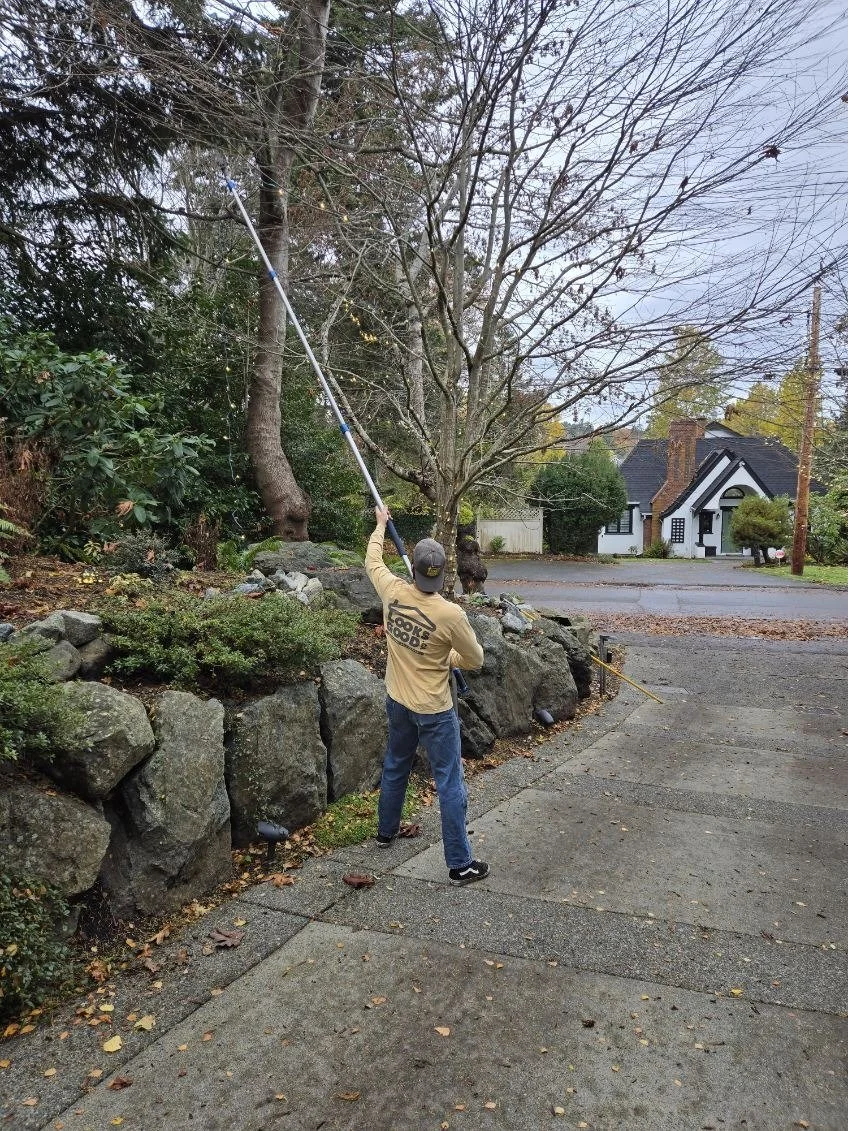
Worker standing on a driveway uses a long extension pole to place a string of Christmas lights high in a bare deciduous tree
The safety rules above still apply, and trees bring one more. Ontario's Electrical Safety Authority warns that power lines can be hidden by trees (ESA homeowner handbook). Check where the lines are before you put a ladder or a pole anywhere near the branches, and remember that a pole counts as part of your reach under BC Hydro's distance rule. If the branches you want to light are close to a line, leave them dark or call someone who does this work.
So which should you choose?
Go permanent if you plan to stay in the house for years and you'd like lights you can use beyond December. That's the option we recommend for most homes.
Go seasonal if you might move soon, you don't want lights on the house year-round, or hanging them is a family tradition you want to keep. Take seasonal sets down after the holidays, as Technical Safety BC advises.
LooksGood does both, with Govee permanent installs and a traditional seasonal Christmas light service.
Want a hand with yours?
Whichever way you go, you can reach LooksGood through the contact page or by phone at 250-896-9563.